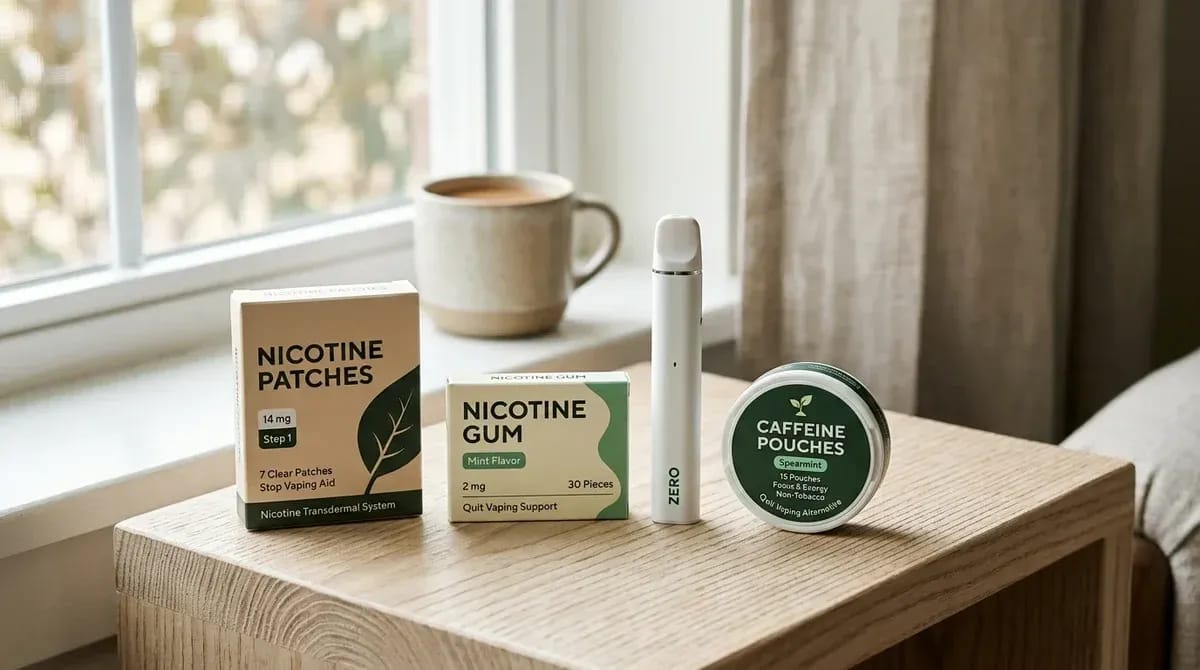
The most effective quit-vaping products address both the nicotine addiction and the behavioral habit — nicotine replacement therapy (patches, gum, lozenges) handles withdrawal, while nicotine-free vapes and caffeine pouches replace the hand-to-mouth ritual that keeps people reaching for their device. The FDA has not approved any product specifically for quitting vaping, but NRT products approved for smoking cessation are commonly used off-label.
Key Takeaway: NRT and prescription medication treat nicotine withdrawal; nicotine-free vapes and pouches don't. We make nicotine-free vapes and Focus Pouches, but we don't sell them as quit aids.
We've spent eight years in the nicotine-free vape space and have watched the quit-vaping product category evolve from "just use willpower" to a legitimate ecosystem of devices, pharmaceuticals, and behavioral tools. This guide breaks down every product category — what works, what the data says, and where our own products fit in (and where they don't).
What Products Actually Help You Quit Vaping?
Quit-vaping products fall into five categories: nicotine replacement therapy, prescription medications, nicotine-free vapes (the step-down method), oral fixation replacements, and digital support tools. Most people who successfully quit use a combination.
The Truth Initiative's 2023 research found that unassisted quitting — willpower alone, no products — has the lowest success rate among all cessation methods. A meta-analysis published in Addiction (Lindson et al., 2019; Lindson et al., Cochrane Database of Systematic Reviews, 2019) confirmed that combining pharmacotherapy with behavioral support significantly increases the odds of long-term abstinence compared to either approach alone.
Mass General Brigham's cessation program recommends pairing NRT with a behavioral substitute — something that physically replaces the hand-to-mouth motion and the oral sensation. That's the strategy this article is built around.
Quit Vaping Products Compared
| Product Type | Example | Nicotine | Addresses Habit? | Addresses Addiction? | Cost |
|---|---|---|---|---|---|
| NRT Patch | NicoDerm CQ | Yes (step-down) | No | Yes | ~$30/box |
| NRT Gum | Nicorette | Yes (step-down) | Partially | Yes | ~$30/box |
| Prescription | Varenicline (Chantix) | No | No | Yes | ~$50/mo |
| NF Vape | Cyclone Pods Gust Pro | None added | Not sold as a quit aid | No | $20 |
| NF Vape | ARRØ | Zero | Yes | No | ~$25 |
| Caffeine Pouch | Cyclone Focus Pouches | Zero | Not sold as a quit aid | No | $9.99/20 |
| Flavored Air | CAPNOS Zero | Zero | Yes | No | ~$12 |
Notice the gap in the table: no single product addresses both the addiction and the habit. That's why the most effective approach stacks two products — one from the left side of the table (NRT or prescription) to handle withdrawal, and one from the right (NF vape, pouch, or inhaler) to handle the behavioral loop.
Nicotine Replacement Therapy (NRT)
NRT is the most studied cessation tool available. Patches, gum, lozenges, and sprays deliver controlled doses of nicotine while you taper off. The FDA approved these for smoking cessation, and physicians routinely prescribe them off-label for vaping cessation.
Patches (NicoDerm CQ, generic store brands): 24-hour slow-release nicotine through the skin. The standard step-down program runs 8-12 weeks: start at 21mg, drop to 14mg, then 7mg. Patches handle baseline cravings but do nothing for the behavioral habit. You'll still want to reach for something with your hands. Cost runs about $30 for a two-week supply.
Gum (Nicorette, generic): Available in 2mg and 4mg doses. The chewing motion partially addresses oral fixation, which gives gum an edge over patches for people whose habit is strongly tied to having something in their mouth. The downside: taste is harsh, jaw soreness is common, and the "park and chew" technique takes practice. About $30 for 100 pieces.
Lozenges (Nicorette Mini Lozenges, generic): Dissolve in the mouth over 20-30 minutes. Like gum, they partially address oral fixation. Available in 2mg and 4mg strengths. Better tolerated than gum by most users — no chewing required. Similar price point.
Nicorette QuickMist: A nicotine mouth spray that delivers 1mg per spray. The NHS specifically mentions QuickMist as a suitable NRT option for people quitting vaping. About $25-35 per bottle.
A Cochrane Collaboration systematic review (Hartmann-Boyce et al., 2018; Hartmann-Boyce et al., Cochrane Database of Systematic Reviews, 2018) found that combination NRT — a patch plus a fast-acting form like gum or lozenge — increases quit rates by 15-36% compared to a single NRT product. If you're serious about quitting, use two forms.
Prescription Medications
Two prescription drugs are FDA-approved for smoking cessation and used off-label for vaping.
Varenicline (formerly Chantix): A partial nicotine receptor agonist — it binds to the same brain receptors as nicotine, reducing both the reward from vaping and the severity of withdrawal. Pfizer recalled the brand-name Chantix in 2021 over a nitrosamine impurity concern, but generic varenicline returned to the market in 2023 after the issue was resolved. It's the most effective single-product cessation aid in clinical trials. Typical cost: $30-60/month with insurance. Requires a doctor's prescription and a 12-week course.
Bupropion (Zyban, Wellbutrin): An antidepressant that also reduces nicotine cravings and withdrawal symptoms. Less effective than varenicline in head-to-head trials, but a reasonable alternative for people who can't tolerate varenicline's side effects (nausea is the most common). Some physicians prescribe bupropion alongside NRT for a dual approach. Cost: $15-40/month generic.
Talk to your doctor before starting either medication. We're a vape company, not a medical practice — this section is informational context, not clinical advice.
Nicotine-Free Vapes: The Step-Down Method
The step-down method works like this: switch from your nicotine vape to a 0mg device, keep the ritual identical, and let nicotine withdrawal run its course while your hands and mouth still have something to do. Once the chemical dependency breaks (usually 7-21 days), you're left with the behavioral habit on its own. No long-term studies have tested this approach.
The hard part of quitting isn't always the nicotine. For a lot of people, it's the absence of the ritual.
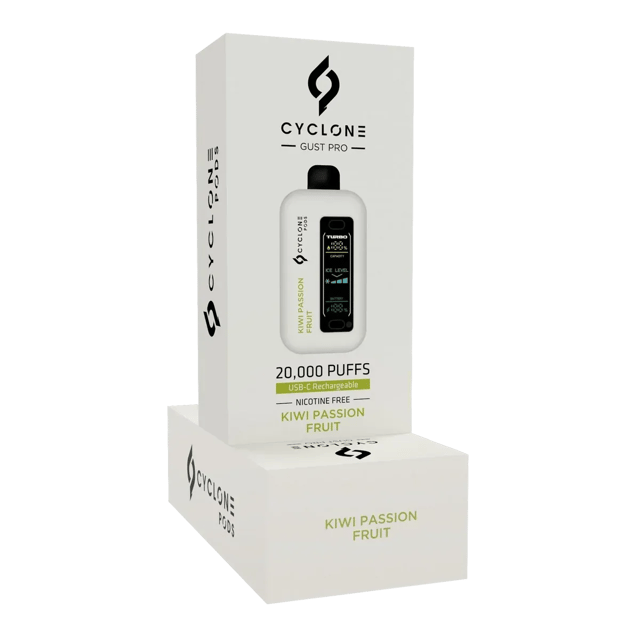
Cyclone Pods Gust Pro — our flagship nicotine-free vape, not sold as a quit aid. 20,000 puffs, $20, USB-C rechargeable with turbo mode and four ice settings. Fourteen flavors. Every Cyclone Pods product is made with no added nicotine. Gust Pro and Lightning vapes are tested by Legend Technical Services, Inc. (ISO 17025 accredited, LC-MS/MS testing, detection limit 0.063 µg/g): 13 of 16 flavors came back non-detect for nicotine, with trace amounts in 3 (Work Order #2503988). We don't make nicotine products at all. USP-grade VG and PG base. Made without diacetyl or vitamin E acetate.
ARRØ — another nicotine-free-only brand. Smaller puff count than the Gust Pro, priced around $25. Clean ingredient list. Decent flavor range. We consider them a legitimate competitor in this space.
Ripple+ — markets botanical and vitamin-infused nicotine-free vapes. The vitamin-delivery-via-inhalation claim is unproven — the bioavailability of inhaled vitamins hasn't been established in peer-reviewed research. But as a nicotine-free behavioral substitute, the device itself works fine.
The honest limitation: a nicotine-free vape doesn't treat nicotine addiction. It doesn't block receptors or taper your intake. If your dependency is primarily chemical (heavy shaking, irritability, strong physical withdrawal), pair the NF vape with NRT. The vape handles the habit. The patch handles the chemistry. Alternatives to vaping covers additional options if you want to skip inhalation entirely.
Oral Fixation Replacements
Not everyone wants to keep vaping — even at 0mg. For people who want a clean break from the inhale-exhale motion but still need something to occupy their mouth and hands, oral fixation products fill that gap.
Cyclone Pods Focus Pouches — $9.99 for a pack of 20. Each pouch contains 50mg of guarana-sourced caffeine plus phosphatidylserine (from soy) plus five herbal and mushroom extracts: ashwagandha, lion's mane, reishi, cordyceps and bacopa monnieri. The caffeine gives you a mild energy lift (the FDA considers up to 400mg/day safe for most adults), and the adaptogen stack is designed for sustained focus without the jitters. Four flavors: Cinnamon, Mint, Peach, Wintergreen. No inhalation. Zero nicotine, zero tobacco.
The trade-off: pouches don't replicate the hand-to-mouth motion or the visual exhale. If those are your primary triggers, a nicotine-free vape is a better behavioral match. If your trigger is more about having something in your mouth — the sensation of a pod or cigarette between your lips — pouches work well.
CAPNOS Zero — a "quit vaping device" that delivers flavored air with a slight cooling sensation. No liquid, no vapor, no nicotine. About $12. The physical form factor mimics a vape closely. The AIO (Google's AI Overview) for "quit vaping products" specifically mentions CAPNOS as an oral fixation tool — it's gaining recognition in this space. Downside: no real substance delivery means the satisfaction fades faster for some users.
QuitGo — a smokeless inhaler, about $8. Delivers flavored air through a cigarette-shaped tube. More targeted at smokers than vapers, but the principle is the same. Basic product with limited flavor options.
Quit Vaping Apps and Support Programs
Products handle the physical side. Apps and programs handle the psychological side — tracking progress, identifying triggers, and providing accountability when cravings hit.
quitSTART (Smokefree.gov): Free app from the U.S. government's Smokefree initiative. Originally designed for teen smokers but widely used by adult vapers. Tracks cravings, provides distraction games during urge episodes, and sends motivational alerts. The craving tracker data is genuinely useful — after two weeks, most users can identify their top three trigger situations.
Text DITCHVAPE to 88709: The Truth Initiative's text-based quit program for vapers specifically (not smokers). You get a 4-6 week automated coaching sequence via text messages. Free. The Truth Initiative reports that participants who complete the program are twice as likely to attempt quitting compared to a control group.
EX Program (Truth Initiative + Mayo Clinic): A more structured online program with community forums, a quit plan builder, and personalized coaching. Free at BecomeAnEX.org. Backed by Mayo Clinic research.
Smokefree.gov: Comprehensive government resource with quit plans, craving management tools, and links to state quitlines. Every state operates a free telephone quitline — call 1-800-QUIT-NOW for your local service.
Digital tools work best as a layer on top of physical products, not as a standalone strategy. Use the app to track and plan. Use the products to manage the physical cravings and behavioral habits.
How to Build Your Quit Plan
Reading about products is step one. For the method itself (cold turkey vs a taper, and what withdrawal looks like week by week), see our guide on how to quit vaping. Actually quitting requires a plan with a date, a product stack, and a support system. Here's the framework that combines the evidence from Mass General, Smokefree.gov, and what we've seen work with our customers:
Step 1: Set a quit date 2-4 weeks out. Don't quit tomorrow on impulse. Use the lead time to order your products and tell at least one person about your plan. Social accountability matters.
Step 2: Identify your triggers. Track when you vape for three days. Most people discover 3-5 recurring triggers: morning coffee, driving, work breaks, stress, boredom. Each trigger needs a specific replacement behavior — not just "I'll resist."
Step 3: Choose your product stack. Based on the comparison table above, pick one product for the addiction and one for the habit:
- Heavy nicotine dependency + strong hand-to-mouth habit: NRT patch + nicotine-free vape
- Moderate dependency + oral fixation primary: NRT gum + caffeine pouches
- Light dependency + want a clean break: Caffeine pouches or CAPNOS alone
- Severe dependency + previous failed attempts: Varenicline (prescription) + nicotine-free vape
Step 4: Set up your environment. Remove all nicotine vapes from your home, car, and workspace on quit day. Have your replacement products physically in hand before you throw anything away. The first 72 hours are the hardest — withdrawal symptoms peak around day 3 and decline significantly by day 7-10.
Step 5: Enroll in a support program. Text DITCHVAPE to 88709 or download quitSTART before your quit date. Having the support infrastructure ready means you won't scramble for help during a craving.
Step 6: Plan for relapse. Slipping once doesn't mean you've failed. The CDC reports that most successful quitters have attempted multiple times before achieving long-term abstinence. If you slip, identify the trigger, adjust your product stack if needed, and set a new quit date within 48 hours.
Why the Combination Approach Works
The EVALI crisis of 2019-2020 (2,807 hospitalizations and 68 deaths according to the CDC) accelerated public awareness of vaping risks, but it didn't produce better cessation tools. Most of those hospitalizations were linked to illicit THC cartridges containing vitamin E acetate, not commercial nicotine vapes — but the health scare pushed many vapers toward quitting.
The problem: most people tried willpower alone. They threw away their devices and white-knuckled through withdrawal while also battling the behavioral loop simultaneously. Attacking both fronts at once is why unassisted quitting has such poor success rates.
The combination approach splits the problem in half. NRT or medication neutralizes the chemical withdrawal. A behavioral substitute (nicotine-free vape, caffeine pouch, or flavored inhaler) fills the ritual gap. You're fighting one battle at a time instead of two.
Once the nicotine dependency breaks — typically after the NRT taper completes at 8-12 weeks — you're left with just the behavioral habit and a 0mg device or pouch. From there, tapering the behavioral tool is dramatically easier because there's no chemical reinforcement pulling you back.
Not sure which quit-vaping product is right for you? Take our product recommendation quiz to find the best option for your situation. For a deeper look at the safest vaping options available, or to see our independent lab testing results, those pages have the full data.