Yes, you can take a vape on a plane — but only in your carry-on bag or on your person. The FAA bans all electronic cigarettes and vaping devices from checked luggage because their lithium batteries pose a fire risk in the cargo hold. You can't use or charge a vape onboard, and the same rules apply to nicotine-free vapes.
That rule is federal, not airline-specific. It applies to every domestic and international flight departing from a U.S. airport, whether you're carrying a disposable vape, a pod system, or a box mod. "Can you bring a vape on a plane?" is one of the most common questions we hear from customers — and the short answer is always yes, carry-on, with some basic prep. Here is how to pack your vape for a flight, what TSA vape rules look like at the checkpoint, and which countries will confiscate your device on arrival.
TSA's own "What Can I Bring?" entry for electronic cigarettes and vaping devices reads: "Carry On Bags: Yes (Special Instructions). Checked Bags: No" (TSA, last updated March 29, 2023; accessed Oct. 9, 2026). The FAA's PackSafe guidance adds that these devices "must never be used or charged in the aircraft" (FAA, Vapes on a Plane, last updated April 13, 2026; accessed Oct. 9, 2026). A nicotine-free vape still runs on a lithium battery, so TSA and the FAA treat it exactly like a nicotine one.
| Item | Carry-on or on you | Checked bag | Source |
|---|---|---|---|
| Vape or e-cigarette (disposable, pod or mod; nicotine or nicotine-free) | Yes. Prevent accidental activation (power off, lock, or a case) | No | TSA; 49 CFR 175.10(a)(19) |
| Spare lithium-ion batteries (100 Wh or less each) | Yes. Terminals protected: retail packaging, tape, or one battery per pouch | No | 49 CFR 175.10(a)(19); FAA PackSafe: Lithium Batteries |
| Carry-on that gets gate-checked or checked planeside | Take the vape and spare batteries out and keep them with you in the cabin | No | FAA PackSafe: Lithium Batteries; FAA, Vapes on a Plane |
| Power bank you charge the vape from | Yes | No | FAA PackSafe: Lithium Batteries |
| E-liquid bottles | 3.4 oz (100 ml) or less per container, inside your quart-size liquids bag | Yes, for larger containers | TSA liquids rule |
| Charging the vape or its batteries during the flight | Not allowed | n/a | 49 CFR 175.10(a)(19); FAA, Vapes on a Plane |
| Vaping in your seat or the lavatory | Not allowed | n/a | 14 CFR Part 252 (81 FR 11415, March 4, 2016) |
TSA Rules for Vapes in 2026
TSA's checkpoint rule points back to the federal hazardous-materials regulation, 49 CFR § 175.10(a)(19), which covers "battery-powered portable electronic smoking devices (e.g., e-cigarettes, e-cigs, e-cigars, e-pipes, e-hookahs, personal vaporizers, electronic nicotine delivery systems)." Here's what that means in practice:
Carry-On: Yes. Checked Bags: No.
Every vaping device with a lithium battery must go in your carry-on or stay in your pocket. This includes disposable vapes like the Gust Pro, pod systems, refillable mods, and even spare batteries. TSA screeners are trained to flag these items in checked luggage X-rays. If they find one, they'll open your bag and remove it — which delays your luggage and may result in a note from TSA in your suitcase.
Battery Rules
Lithium-ion batteries in vapes must not exceed 100 watt-hours (Wh) per battery. Nearly every consumer vape falls well under this threshold — for context, 100 Wh is roughly the size of a small laptop battery. Spare batteries need individual protection: keep them in their original packaging, a battery case, or cover the terminals with tape. Loose batteries rattling around in a bag are a fire hazard.
The same regulation bans charging in the air: "Recharging of the devices and/or the batteries on board the aircraft is not permitted." Charge your vape at the gate, not from the seat-back USB port. TSA also tells passengers to "check with your airline on any limitations on the number of devices that can be carried for personal use."
Liquid Limits
Vape juice is subject to the same 3-1-1 liquid rule as shampoo and toothpaste: containers must be 3.4 oz (100 ml) or smaller, all fitting inside a single quart-sized clear bag. Most pre-filled pods and disposable vapes hold far less — the Gust Pro comes pre-filled, so there's no e-liquid to measure or bag. Pod systems with refillable cartridges usually hold 2-7 ml, well within the limit.
Can You Vape on a Plane?
No. Using a vaping device on a commercial aircraft is a federal offense, in the FAA's own words (FAA, accessed Oct. 9, 2026). Full stop.
The ban comes from the Department of Transportation. Its rule at 14 CFR Part 252 (81 FR 11415, March 4, 2016) defines smoking to include "electronic cigarettes whether or not they are a tobacco product" and requires U.S. airlines, and foreign airlines on flights to or from the U.S., to prohibit it on scheduled passenger flights in "all locations within the aircraft," lavatories included. A separate FAA rule, 14 CFR 121.317, says no person may tamper with, disable or destroy a lavatory smoke detector.
Penalties are real:
- FAA civil fines: The FAA can propose up to $43,658 per violation in unruly-passenger cases, which include failing to follow crew instructions, and one incident can bring several violations (FAA, accessed Oct. 9, 2026)
- Smoke-detector tampering: The placard required in every airline lavatory reads "Federal law provides for a penalty of up to $2,000 for tampering with the smoke detector installed in this lavatory" (14 CFR 121.317(e)). The FAA refers unruly-passenger incidents to the FBI when warranted.
- Travel restrictions: Per the FAA, unruly behavior "can affect your TSA PreCheck® eligibility or land you on an internal no-fly list for an airline."
Don't do it. Don't do it in your seat, don't do it in the lavatory, don't "zero out" the hit and assume nobody will notice. The ban covers the lavatory by name.
If you need to manage cravings during a flight, nicotine pouches or gum are the standard workaround for nicotine users. If you're already using nicotine-free vapes, the cravings won't be chemical — the oral fixation is the only thing you're fighting, and that passes. A long-haul flight is uncomfortable, not impossible. Bring gum, bring a book, and use your vape once you clear the arrivals terminal.
How to Pack Your Vape for a Flight
Getting through TSA with a vape is straightforward if you pack correctly. Here's our checklist:
- Empty or reduce the tank. Cabin pressure changes can cause e-liquid to leak from refillable tanks. Drain yours before boarding, or fly with a pre-filled disposable or pod system that has no tank to open. The Gust Pro comes pre-filled from the factory, so there is nothing to top up or drain.
- Turn it off or lock it. If your device has a power button, turn it off. If it's a draw-activated disposable, keep it in a case or protective pouch to prevent accidental activation in your bag.
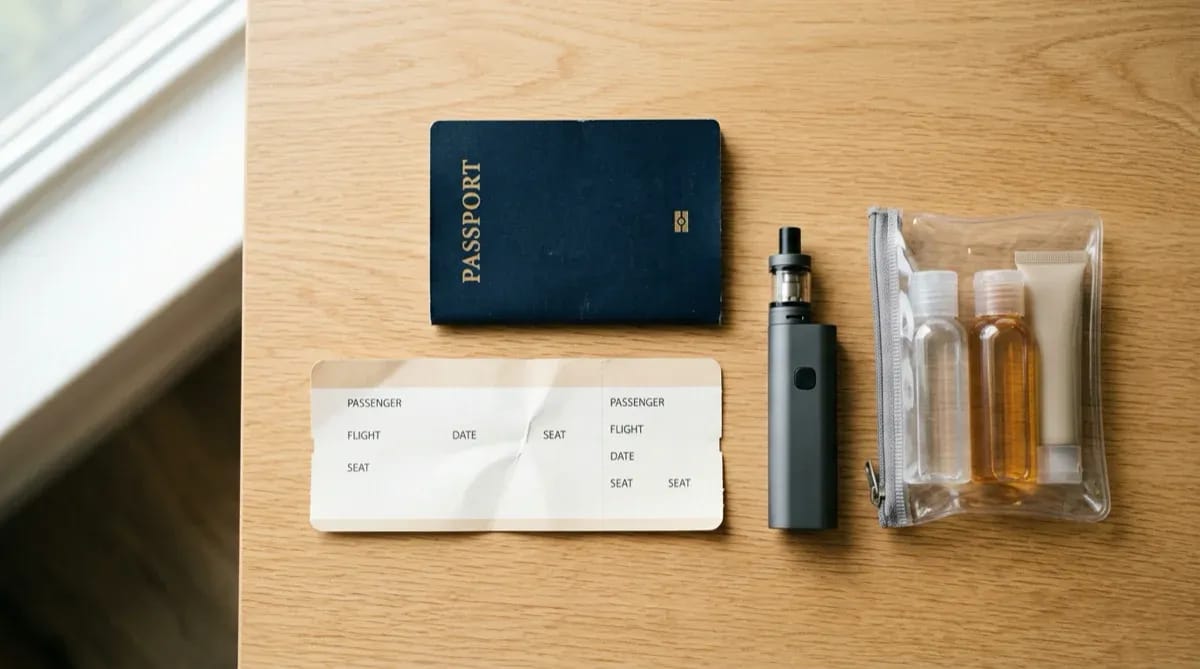
- Carry-on only. Put the device in your carry-on bag or jacket pocket. Never pack it in checked luggage.
- Protect spare batteries. Store them in a dedicated battery case or their original packaging. Cover exposed terminals with electrical tape if no case is available.
- Bag your juice. If you're carrying bottles of e-liquid, put them in your quart-sized clear bag alongside your other liquids. Containers must be 100 ml / 3.4 oz or smaller.
- Don't hide it. You don't need to declare your vape at the checkpoint, but don't try to conceal it. TSA officers see them on X-ray every day. Treat it like a phone or portable charger.
The simplest travel setup? A single disposable vape in your pocket. No charger, no juice bottles, no spare batteries. The Gust Pro lasts 20,000 puffs with USB-C recharging — enough for a two-week trip without carrying extras.
Going longer? The Gust Core rechargeable disposable is rated 50,000 puffs from a sealed, pre-filled 18ml tank, so one device covers a long trip. It charges over USB-C in under an hour, its OLED shows liquid and battery before you board, and it is assembled in the USA. $25.
International Travel: Vape Laws by Country
TSA rules get you out of the U.S. What happens when you land is a different story. Many countries ban vaping devices entirely, and penalties range from confiscation to prison time. Check your destination before you pack.
| Country | Vape status | Penalty or traveler rule | Source |
|---|---|---|---|
| Thailand | Banned: import and sale of e-cigarettes and e-liquids | Customs Act: fine of four times the item's value and/or up to 10 years in prison; tourists have been fined on arrival | TobaccoControlLaws.org, updated Sept. 30, 2025; Bangkok Post, Nov. 8, 2018 |
| Singapore | Banned: import, sale, purchase, possession and use | Since May 1, 2026: fine up to S$10,000 for buying, using or possessing a vape; importers face mandatory jail of up to 9 years and fines up to S$300,000 | Singapore Ministry of Health, March 6, 2026 |
| India | Banned: production, import, export, transport, sale and storage | Up to 1 year in prison and/or a fine up to ₹1 lakh (₹100,000) for a first offense under section 4 | Prohibition of Electronic Cigarettes Act, 2019, s. 7 |
| Brazil | Banned: manufacture, import (including in accompanied luggage), sale, storage and transport | Set by ANVISA Resolution 855 (April 23, 2024), which also bans use in enclosed public places | TobaccoControlLaws.org, updated Aug. 20, 2024; WHO FCTC |
| Argentina | Banned: import, sale, distribution and advertising | No traveler penalty is stated in ANMAT Order 3226/2011 | TobaccoControlLaws.org, updated Feb. 3, 2020 |
| Mexico | Illegal to bring in any vaping device, e-cigarette, pod or e-liquid | Confiscation, fines of over $10,000, or arrest, per the U.S. Embassy | U.S. Embassy Mexico, March 2, 2026 |
| Taiwan | Banned: use, import, sale and supply | Customs confiscates the device; the local health bureau can fine at least NT$50,000 | TobaccoControlLaws.org, updated Feb. 11, 2024; Taipei Times, Sept. 22, 2026 |
| Japan | Legal. Nicotine e-liquid is regulated as a medicine; nicotine-free liquid is not | Customs clears one month's supply of nicotine liquid (120 ml, or 60 cartridges) and one device plus one spare; more needs an import certificate | Japan Ministry of Health, Labour and Welfare import Q&A, Nov. 30, 2015 |
| Australia | Restricted: every vape, with or without nicotine, is a therapeutic good sold only through pharmacies | Traveller's exemption: up to 2 vapes, 20 accessories (pods, cartridges) and 200 mL of liquid for your own treatment | Therapeutic Goods Administration, updated Oct. 1, 2024 |
| UK | Legal to use. Selling single-use (disposable) vapes has been banned since June 1, 2025, with or without nicotine | The ban targets sellers and suppliers; the guidance sets no traveler limit | UK DEFRA guidance, updated July 3, 2025 |
| Canada | Legal; federally regulated under the Tobacco and Vaping Products Act | Provinces add their own sales rules | TobaccoControlLaws.org, updated May 5, 2025 |
| UAE | Legal; sale allowed under product standard UAE.S 5030:2018 | Product standards and content limits apply | TobaccoControlLaws.org, updated July 19, 2021 |
We checked each row against the source in its last column on October 9, 2026. Laws change, and several of these changed in the past year. Always check your destination country's customs authority before packing a vape in your carry-on. If you're heading to a country with an outright ban, leave the device at home.
One note for our customers: nicotine-free vapes like the ones we make at Cyclone Pods are treated differently in some jurisdictions. Japan, for example, regulates nicotine e-liquid as a medicine but treats nicotine-free liquid as an ordinary product. Australia does not make that distinction: since 2024 it regulates every vape, with or without nicotine, through pharmacies. Countries with full bans (Thailand, Singapore, India, Mexico) make no distinction either.
The Gust Pro is USB-C rechargeable (same cable as your phone), comes pre-filled with nothing to refill in transit, and at $20 it's low-stakes if customs confiscates it. Use it before boarding, stow it in your carry-on, and pick it back up at your destination.
What Happens If TSA Finds a Vape in Checked Luggage?
If a TSA screener finds a vaping device during checked baggage screening, here's the typical sequence:
- Your bag gets pulled. The vape shows up on the X-ray. A screener opens your bag for a physical inspection.
- The device is removed. TSA will confiscate the vaping device and any associated batteries. You won't get them back.
- You get a notice. TSA leaves a "Notice of Baggage Inspection" card in your bag so you know they opened it.
- Your bag may be delayed. The extra screening takes time. Your bag might not make it onto your flight.
We haven't found a published TSA fine schedule for an accidental vape in a checked bag. The FAA's PackSafe page says dangerous goods that are improperly packed or not permitted in baggage "are subject to civil and criminal penalties as appropriate" (accessed Oct. 9, 2026).
The fix is simple: always keep your vape in your carry-on. If you forgot and realized after dropping your bag at check-in, some airlines will let you retrieve items at the counter before the bag enters the system. Ask immediately — once the bag hits the belt, it's out of your hands.
Worth noting: this rule applies to all vaping devices regardless of nicotine content. Whether your device contains nicotine, CBD, or nothing at all, the FAA's restriction is about the lithium battery, not what's in the tank. A nicotine-free disposable gets the same treatment as a nicotine salt pod system.
Disposable Vapes vs. Refillable: Which Is Easier to Travel With?
Disposable vapes win for travel convenience. Here's why:
- No liquid to manage. Sealed tanks mean no 3-1-1 bag, less leak risk from cabin pressure, and no measuring containers. Refillable systems require you to carry juice bottles through security.
- No spare batteries. Disposables have integrated batteries. Refillable mods often need spare 18650 cells, which means battery cases, terminal tape, and more items to track.
- No charger (usually). A Gust Pro with 20,000 puffs will outlast most vacations. The Gust Core has a built-in rechargeable battery (USB-C), so it travels in your carry-on like any vape. If it does need a charge, it uses USB-C — the same cable as your phone. No proprietary chargers to forget.
- Nothing to disassemble. Some refillable setups need to be taken apart to prevent leaking at altitude. Disposables don't.
- Lower financial risk. If your destination country confiscates your vape at customs, losing a $20 disposable hurts less than losing a $60+ mod kit.
That said, if you're a frequent traveler and prefer a reusable device, pod systems like the Lightning are a good middle ground. The pods come prefilled with 7 ml of e-liquid, the magnetic connection makes swapping easy, and at $14 per pod, the replacement cost is manageable if one gets confiscated.
Can You Bring Vape Juice on a Plane?
Yes, but the same liquid restrictions that apply to every other liquid in your carry-on apply here.
TSA's 3-1-1 rule:
- 3.4 oz (100 ml) maximum per container
- 1 quart-sized clear plastic bag
- 1 bag per passenger
Most e-liquid bottles sold at retail are 30 ml, 60 ml, or 120 ml. The 120 ml bottles exceed the limit — you'll need to transfer liquid into a smaller container or buy travel-sized bottles. The 30 ml and 60 ml bottles are both under the cap and can go straight into your clear bag.
Practical tips:
- Squeeze the air out of partially full bottles before sealing. Reduced air means less expansion at altitude, which means less leaking.
- Bag them separately. Even inside the clear bag, put e-liquid bottles in a small zip-lock of their own. If one leaks, it doesn't ruin your toiletries.
- Consider pre-filled pods. If you use a pod system, carrying sealed pre-filled pods is easier than bottles. They're within the liquid limit, unlikely to leak, and don't need to go in the clear bag (though TSA may ask — keep them accessible).
You can also pack larger bottles of vape juice in checked luggage. The liquid restriction only applies to carry-ons. Just make sure each bottle is sealed tightly and bagged against leaks — pressure and temperature still change during a flight, and that can loosen caps.
Remember: the liquid goes in checked luggage, but the device does not. Juice in checked bags is fine. Batteries in checked bags is a federal no-go. If you're flying with a vape and bringing extra juice, split them up — device in your carry-on, backup bottles in your suitcase.
The Bottom Line
Flying with a vape is legal and simple if you follow two rules: carry-on only, and don't use it on the plane. The FAA's lithium battery regulation is the reason your vape can't go in checked luggage, and the federal smoking prohibition is why you can't use it in the air. Both rules carry real consequences: confiscation, FAA fines of up to $43,658 per violation, and potential criminal charges.
Pack your device in your carry-on. Turn it off. Keep your liquids in a clear bag. Check your destination country's laws before departure. That's it.
For a vape that adds no hassle at security, we'd pick the Gust Pro: 20,000 puffs, USB-C charging, sealed tank, no nicotine, $20. One device, one cable, zero liquid management. It'll last your whole trip and won't break the bank if customs in Bangkok decides to keep it.
For more on choosing the right device, check out our guide to the safest vapes on the market.