Yes, caffeine can cause anxiety. It blocks adenosine receptors in the brain, triggering adrenaline and cortisol release — the same hormones your body produces during a fight-or-flight response. At high enough doses, or in genetically susceptible individuals, this creates symptoms indistinguishable from an anxiety disorder: racing heart, restlessness, chest tightness, and an overwhelming sense of dread.
That's not speculation. The DSM-5 includes "caffeine-induced anxiety disorder" as a recognized diagnosis (code 292.89). The mechanism is well-documented, the dose-response relationship is established, and the fix is straightforward. Here's what the research actually says.
How Caffeine Triggers Anxiety
Caffeine's primary mechanism is blocking adenosine, a neurotransmitter that promotes relaxation and sleepiness. When adenosine can't bind to its receptors, your brain interprets the situation as "something important is happening" and launches a cascade of stimulatory responses.
Three systems drive caffeine-related anxiety:
1. Adenosine blockade. Adenosine normally inhibits neural activity. Caffeine is an adenosine receptor antagonist — it fits into adenosine receptors without activating them, blocking the real thing from doing its job. The result: neurons fire faster, and your brain shifts toward a state of heightened arousal. A 2010 review in the Journal of Alzheimer's Disease describes how caffeine acts mainly by blocking A1 and A2A adenosine receptors (Ribeiro & Sebastião, 2010; PMID: 20164566).
2. Cortisol and adrenaline release. Caffeine stimulates the hypothalamic-pituitary-adrenal (HPA) axis, increasing cortisol secretion. It also triggers the release of epinephrine (adrenaline) from the adrenal glands. A study published in Psychosomatic Medicine found caffeine raised cortisol robustly after a few days without it, and that daily use reduced but did not eliminate that response (Lovallo et al., 2005; PMID: 16204431). Elevated cortisol + adrenaline is the biochemical signature of anxiety.
3. GABA interference. Caffeine may also reduce the effectiveness of GABA, the brain's primary inhibitory neurotransmitter. GABA is what keeps your nervous system from running too hot. When GABA signaling weakens, excitatory neurotransmission dominates — and the subjective experience is anxiety, restlessness, and an inability to relax.
These three mechanisms compound. You're not just more alert — you're more alert, more stressed, and less able to calm yourself down. For most people at moderate doses, this feels like productive energy. For anxiety-prone individuals, it feels like a panic attack.
The speed of onset matters too. Caffeine reaches peak blood concentration in 30–60 minutes after oral ingestion. That means the full anxiogenic effect hits before most people finish their second cup. If you're sipping a large coffee over an hour, the first dose peaks while you're still adding to it — creating a compounding effect that overshoots your intended intake.
How Much Caffeine Causes Anxiety?
The dose-response relationship between caffeine and anxiety is nonlinear and highly individual. But research gives us usable thresholds.
A 2002 review of caffeine and behavior in Food and Chemical Toxicology found that the doses most people drink improve alertness, while anxiety effects appear mainly at higher doses and in sensitive people (Smith, 2002; PMID: 12204388).
Here's how common caffeine sources stack up:
| Source | Caffeine (mg) | Anxiety Risk |
|---|---|---|
| Drip coffee (8 oz) | 95 | Low-moderate (variable extraction) |
| Espresso (double shot) | 126 | Moderate |
| Energy drink (16 oz) | 80–300 | Moderate-high (sugar + taurine amplify) |
| Pre-workout supplement | 150–400 | High |
| Cyclone Focus Pouches | 50 | Low (50 mg label dose, no sugar) |
| Green tea (8 oz) | 28 | Very low |
But the number on the label isn't the whole story. Three factors determine whether a given dose triggers anxiety in you:
- CYP1A2 genotype. This liver enzyme metabolizes caffeine. "Slow metabolizers" (roughly 40–45% of the population) break down caffeine at half the normal rate, meaning the same dose hits harder and lasts longer. A 200 mg cup of coffee in a slow metabolizer behaves more like 300–400 mg in a fast metabolizer.
- Baseline anxiety level. If your nervous system already runs hot — whether from a diagnosed anxiety disorder, chronic stress, or poor sleep — caffeine has more raw material to amplify.
- Tolerance. Daily caffeine users develop partial tolerance to its anxiogenic effects over 1–4 weeks. Occasional users experience significantly stronger anxiety responses at identical doses.
The practical takeaway: if you're anxiety-prone, your personal ceiling is probably closer to 100–150 mg per sitting, not the FDA's 400 mg daily max for healthy adults. That's one cup of coffee, or two to three caffeine pouches spaced throughout the day.
Caffeine and Anxiety Disorders
The DSM-5 (Diagnostic and Statistical Manual of Mental Disorders, Fifth Edition) recognizes caffeine-induced anxiety disorder as a clinical diagnosis under substance/medication-induced anxiety disorder (code 292.89). The diagnostic criteria require that the anxiety symptoms developed during or shortly after caffeine intoxication and are not better explained by an independent anxiety disorder.
This isn't a fringe classification. Research supports a direct link between caffeine and clinically significant anxiety in vulnerable populations:
Generalized Anxiety Disorder (GAD). Individuals with GAD show exaggerated responses to caffeine compared to healthy controls. A study by Bruce et al. (1992) found that patients with panic disorder experienced significantly more anxiety after 480 mg of caffeine than controls — and some experienced full panic attacks (PMID: 1444724).
Panic Disorder. Caffeine is used as a panicogenic agent in research settings — meaning researchers intentionally administer it to provoke panic attacks in susceptible individuals. A 1985 study in the Archives of General Psychiatry showed that 10 mg/kg of caffeine induced panic attacks in 71% of panic disorder patients versus 0% of controls (Charney et al., 1985; PMID: 2983630).
Social Anxiety Disorder. Less studied, but caffeine's physiological effects — trembling hands, rapid heartbeat, sweating — overlap significantly with social anxiety symptoms. For people who fear being visibly anxious, caffeine creates a self-fulfilling prophecy.
If you have a diagnosed anxiety disorder, the clinical recommendation is unambiguous: reduce or eliminate caffeine, at least temporarily, to establish your baseline anxiety level without stimulant interference. Many people discover that their "treatment-resistant anxiety" was partially caffeine-maintained all along.
Worth noting: caffeine doesn't cause anxiety disorders from scratch. It amplifies existing vulnerability. If you have no predisposition, even high doses will produce jitteriness and discomfort but not clinical anxiety. The distinction matters — caffeine is a trigger and amplifier, not a root cause.
Signs Your Caffeine Intake Is Causing Anxiety
Caffeine-induced anxiety mimics generalized anxiety so closely that many people don't connect the two. The distinguishing feature is timing — symptoms that appear 15–45 minutes after caffeine intake and resolve within 3–6 hours are almost certainly caffeine-related.
Watch for these symptoms:
- Physical: Racing or pounding heart, chest tightness, shallow breathing, trembling hands, sweating, stomach upset, muscle tension
- Cognitive: Racing thoughts, inability to focus (paradoxically — too much stimulation overwhelms rather than sharpens), sense of impending doom, irritability
- Behavioral: Restlessness, pacing, inability to sit still, difficulty making decisions, snapping at people
- Sleep: Difficulty falling asleep, waking at 3 AM with a racing mind, feeling wired-but-tired
A simple diagnostic test: eliminate all caffeine for 7–10 days (expect 1–3 days of withdrawal headaches), then reintroduce a measured dose. If your anxiety symptoms disappear during elimination and return with reintroduction, caffeine is at minimum a contributing factor.
Keep in mind that caffeine hides in unexpected places — chocolate, decaf coffee (which still contains 7–15 mg per cup), certain medications (Excedrin contains 65 mg per tablet), and some protein bars. Track everything during your elimination test.
One more pattern to watch: afternoon anxiety that seems unrelated to caffeine. Because caffeine's half-life is approximately 5 hours, a 200 mg morning coffee still has 100 mg active at lunchtime and 50 mg at dinnertime. If you drink a second cup at noon, you're stacking 200 mg on top of the 100 mg still circulating. That's 300 mg effective — enough to trigger anxiety in most sensitive individuals, even though neither cup alone would have.
How to Reduce Caffeine Anxiety
If caffeine is triggering your anxiety but you don't want to quit entirely, these strategies are backed by both research and common sense.
1. Taper gradually. Cutting caffeine abruptly triggers withdrawal — headaches, fatigue, irritability, and sometimes increased anxiety (the opposite of what you want). Reduce by 25% every 3–5 days. If you're drinking 400 mg daily, drop to 300 for a few days, then 200, then 100. The entire taper takes about two weeks.
2. Switch to lower-dose sources. The problem often isn't caffeine itself — it's the dose spike. A 16 oz coffee delivers 190 mg in one bolus, which hits your bloodstream in 15–45 minutes. Compare that to a 50 mg caffeine pouch, a much smaller single dose.
3. Time it right. Cortisol peaks naturally between 8–9 AM, noon–1 PM, and 5:30–6:30 PM. Adding caffeine during these windows stacks artificial cortisol on top of natural cortisol — a recipe for anxiety. The optimal windows are roughly 9:30–11:30 AM and 1:30–5 PM. And the hard cutoff is 8–10 hours before bed.
4. Eat first. Caffeine on an empty stomach accelerates absorption, creating a sharper spike and more pronounced anxiety response. Food — especially protein and fat — slows absorption and flattens the curve.
5. Add adaptogens. Ashwagandha has documented anxiolytic (anxiety-reducing) properties. A 2012 randomized controlled trial found that 300 mg of ashwagandha root extract twice daily reduced serum cortisol by 27.9% over 60 days (Chandrasekhar et al., 2012; PMID: 23439798). Pairing caffeine with an adaptogen doesn't cancel out the stimulant effect — but it can blunt the stress-hormone amplification that causes anxiety.
6. Move your body. Exercise metabolizes adrenaline and cortisol. If you feel caffeine anxiety building, a 10-minute walk or brief set of bodyweight exercises can burn off the excess stress hormones faster than waiting it out.
Caffeine Pouches vs. Coffee: Which Is Better for Anxiety-Prone People?
We make caffeine pouches, so take this section with appropriate skepticism. But the pharmacological argument is real.
Coffee's caffeine content is variable and high. An 8 oz cup of drip coffee averages 95 mg, but actual measurements range from 72 to 130 mg depending on bean origin, roast level, grind size, brew time, and water temperature. A 16 oz Starbucks Pike Place contains 310 mg. You never know exactly how much you're getting, and the entire dose hits your GI tract at once.
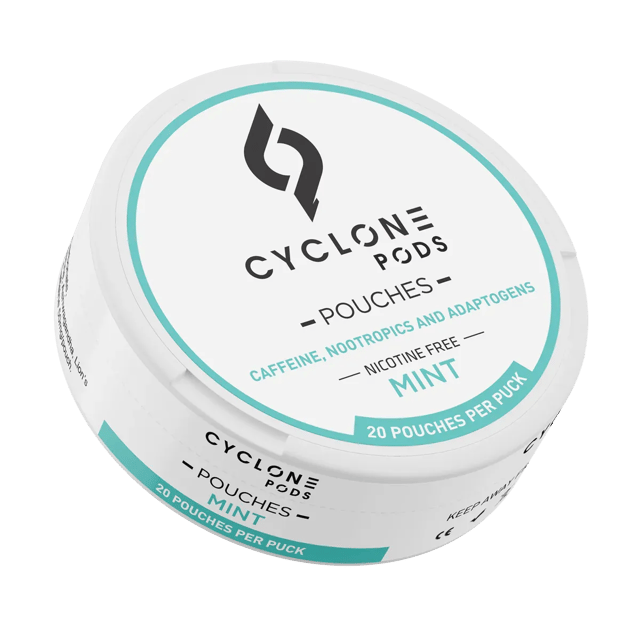
Cyclone Focus Pouches contain a 50 mg of caffeine per pouch (label), from guarana. There's no guessing.
For anxiety-prone people, that difference matters. Here's why:
| Factor | Coffee | Caffeine Pouches (50 mg) |
|---|---|---|
| Dose precision | Variable (72–310 mg) | 50 mg (label) |
| Sugar / calories | 0 (black) to 50g+ (lattes) | ~5 calories, 0 g sugar |
| Acid / stomach upset | Yes (chlorogenic acids) | No |
| Adaptogen pairing | No | Yes (ashwagandha, lion's mane, reishi, cordyceps, bacopa monnieri) |
| Price per dose | $2–6 per cup | $0.50 per pouch ($9.99/20-pack) |
The adaptogen stack in Focus Pouches is relevant here. Ashwagandha is classified as an adaptogen — a compound that helps the body manage stress. The anxiolytic research cited above (PMID: 23439798) used ashwagandha root extract, which is the form in Focus Pouches. It doesn't eliminate caffeine's stimulant effect, but the cortisol-modulating properties may counterbalance the stress-hormone spike that drives caffeine anxiety.
We're not claiming pouches cure anxiety — that would be dishonest. What we're saying is that 50 mg of caffeine (label) paired with adaptogens is a lower-risk profile than 200+ mg of variable-dose coffee for people who are anxiety-sensitive. If you've tried cutting coffee and missed the focus, this is worth trying before going fully caffeine-free.
If you're exploring non-caffeine options for stress management, we've also written about anxiety pens and stress-relief vapes — though those target a different mechanism entirely.
The Bottom Line
Caffeine causes anxiety through a well-understood biochemical pathway: adenosine blockade leads to adrenaline and cortisol release, which mimics (and amplifies) anxiety symptoms. The effect is dose-dependent, genetically influenced, and significantly worse in people with existing anxiety disorders.
What to do about it:
- If you suspect caffeine is driving your anxiety: Eliminate it for 7–10 days, then reintroduce at a measured dose. The answer will be obvious.
- If you want caffeine without the anxiety: Stay under 100–150 mg per sitting, avoid stacking sources, and time intake between cortisol troughs. Consider lower-dose options like caffeine pouches (50 mg) or green tea (28 mg) instead of coffee.
- If you have a diagnosed anxiety disorder: Talk to your doctor. The clinical literature strongly suggests caffeine reduction as a first-line behavioral intervention — it's free, immediate, and frequently underutilized.
Caffeine is the most widely consumed psychoactive substance on the planet. It's not dangerous for most people at moderate doses. But "most people" and "you specifically" are different categories — and if anxiety is part of your life, your caffeine intake deserves a hard look.
Our ingredients are independently lab tested by Certified Laboratories (A2LA accredited, Burbank, CA). We publish the results because transparency matters — especially when you're putting something in your body to manage how you feel.