
A 2026 systematic review by Bozier et al. in Carcinogenesis (UNSW Sydney) found that nicotine-based e-cigarettes cause DNA damage consistent with early-stage carcinogenesis — particularly in lung and oral tissue. But the same body of research reveals a critical gap: nearly all cancer-risk studies involve nicotine-containing products, and long-term epidemiological data linking vaping directly to cancer diagnoses in humans does not yet exist.
That gap matters. It means the honest answer to "can vaping cause cancer?" is neither a clean yes nor a reassuring no. It's a qualified probably, depending on what you're inhaling — and the research is still catching up. Here's where the science actually stands as of 2026, what's been established, what's still unknown, and what you can do to reduce your risk.
What the Latest Research Says About Vaping and Cancer
The evidence base has shifted substantially in the past two years. Until roughly 2024, the mainstream scientific position was that vaping might increase cancer risk but that direct evidence was lacking. That position has hardened.
The 2026 Carcinogenesis Systematic Review
The study driving the current SERP conversation is a 2026 systematic review published in Carcinogenesis by researchers at the University of New South Wales (UNSW Sydney). The review synthesized preclinical and clinical evidence on nicotine-based e-cigarette exposure and concluded that these products cause measurable DNA damage — strand breaks, oxidative lesions, and epigenetic alterations — in lung and oral epithelial cells. These are the same categories of DNA damage observed in early-stage carcinogenesis from tobacco smoke, though at lower concentrations.
The key findings:
- Nicotine-derived nitrosamines (NNK, NNN) — known carcinogens — are present in measurable quantities in nicotine e-cigarette aerosol
- E-cigarette aerosol induces oxidative stress that damages DNA repair mechanisms
- Chronic exposure in animal models produced precancerous cellular changes in lung tissue
- The effects were dose-dependent — heavier use correlated with greater DNA damage
This review did not find that vaping causes cancer in humans. It found that the biological mechanisms for cancer initiation are present and active. That's a meaningful distinction, but not a comforting one.
Supporting Evidence: 2024-2025 Studies
The UNSW review didn't emerge in isolation. Several studies published in 2024-2025 built the foundation:
Kundu et al. (2025), published in Tobacco Induced Diseases, reviewed the accumulated evidence on vaping and cancer risk across multiple organ systems. The paper — which has been cited 44 times as of May 2026 — found consistent evidence of genotoxic and carcinogenic potential in nicotine e-cigarette aerosol, with the strongest associations in lung, oral cavity, and bladder tissue.
Xi et al. (2024) examined the relationship between vaping and tumor metastasis, finding that e-cigarette exposure promoted cancer cell migration and invasion in lung and bladder cancer models. This study was notable because it moved beyond initiation (can vaping start cancer?) to progression (can vaping make existing cancer worse?) — and the answer in animal models was yes.
The American Cancer Society (Delnevo et al., 2024, Cancer Epidemiology, Biomarkers & Prevention) published results from a longitudinal study tracking over 32,000 participants and found that dual users — people who both smoke cigarettes and vape — had approximately 4 times the lung cancer risk compared to non-users. This was among the first large-scale epidemiological findings linking vaping behavior to cancer outcomes, though isolating vaping's independent contribution from smoking's was not possible in dual-use populations.
The Nicotine Variable
Here's what most cancer-risk articles skip: virtually all of the studies cited above tested nicotine-containing e-cigarettes. The carcinogenic mechanisms identified — tobacco-specific nitrosamines, nicotine-mediated DNA damage, promotion of angiogenesis in tumor tissue — are driven by nicotine and its metabolites. When researchers say "e-cigarettes may cause cancer," they mean nicotine e-cigarettes specifically.
That doesn't mean nicotine-free vaping is without risk. It means the primary carcinogenic pathway identified in current research depends on a compound that isn't present in all vaping products. The distinction matters for interpreting headlines.
Does Nicotine-Free Vaping Carry Cancer Risk?
The honest answer: we don't have enough research to say definitively. And that uncertainty cuts both ways.
What we know: removing nicotine from the equation eliminates tobacco-specific nitrosamines (TSNAs) — the class of compounds most directly linked to cancer in vaping research. TSNAs like NNK and NNN are formed from nicotine during the heating process. No nicotine, no nicotine-derived carcinogens. That's a meaningful subtraction.
What we also know: nicotine isn't the only potentially harmful compound in e-cigarette aerosol. When propylene glycol and vegetable glycerin are heated, they can produce:
- Formaldehyde — a Group 1 carcinogen (IARC classification) formed through thermal decomposition of PG, primarily at high temperatures
- Acrolein — a reactive aldehyde formed from glycerol decomposition, classified as a probable human carcinogen
- Acetaldehyde — another thermal decomposition product with carcinogenic potential
These compounds are produced in both nicotine and nicotine-free vapes because they come from the base liquids, not the nicotine. However, concentrations matter enormously. A 2022 review in Toxics found that aldehyde levels in e-cigarette aerosol were 9 to 450 times lower than in cigarette smoke, with significant variation depending on device power, coil temperature, and puff patterns.
What we don't know: whether long-term inhalation of VG/PG aerosol — even without nicotine — causes cancer in humans. No 20-year prospective study on nicotine-free vaping exists. The products haven't been on the market long enough.
What Our Lab Testing Covers
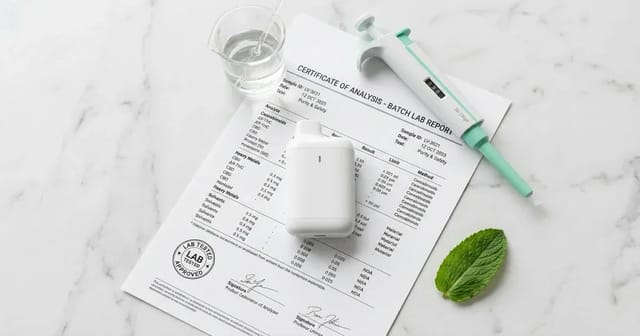
At Cyclone Pods, we test our Gust Pro and Lightning vapes through Legend Technical Services, Inc. — an ISO 17025 accredited laboratory in St. Paul, Minnesota. The testing uses LC-MS/MS (liquid chromatography-tandem mass spectrometry) with a detection limit of 0.063 micrograms per gram (Work Order #2503988).
What testing confirms: 13 of 16 flavors had no detectable nicotine; Lush Ice (0.85), Bold Tobacco (24) and Tobacco (26 µg/g) showed trace amounts. Neither Legend report covers vitamin E acetate. Our vapes are made without it. Our ingredients are USP-grade vegetable glycerin, USP-grade propylene glycol, and food-grade flavorings.
A second panel in July 2026 (Work Order #2602062) widened the net to the carcinogenic heavy metals. Six Gust Pro and Lightning flavors were screened by ICP/MS for arsenic, cadmium, lead, and mercury, and all four came back non-detect in all six flavors tested — alongside a non-detect for diacetyl.
What testing doesn't answer: whether decades of inhaling our product's aerosol carries cancer risk. No lab test can answer that question — only long-term epidemiological data can, and it doesn't exist yet for any nicotine-free vaping brand. We're transparent about that limitation because we think you deserve to make decisions based on what's actually known, not on what a brand wants you to believe.
Vaping vs Smoking: Cancer Risk Comparison
The comparison between vaping and smoking is where the data is clearest — and where context matters most.
Cigarette smoke contains over 7,000 chemicals, at least 70 of which are known carcinogens (American Cancer Society). The combustion process — burning plant matter at 600-900°C — produces polycyclic aromatic hydrocarbons, benzene, arsenic, cadmium, and radioactive polonium-210. There is no debate about whether smoking causes cancer. It does. The mechanism is combustion.
Vaping doesn't involve combustion. E-cigarettes heat liquid to 200-300°C, producing an aerosol rather than smoke. This eliminates the vast majority of combustion-generated carcinogens. A landmark 2015 report by Public Health England (McNeill et al.) concluded that e-cigarettes are approximately 95% less harmful than combustible cigarettes. That figure has been debated — some researchers argue it oversimplifies the comparison — but the directional finding has held up: vaping exposes users to dramatically fewer toxicants than smoking.
Cancer Research UK has stated there is "no good evidence that vaping causes cancer," while acknowledging that e-cigarettes are not risk-free and that long-term data is still needed. Their position reflects the UK's generally more favorable regulatory stance toward vaping as a harm-reduction tool.
The Dual-Use Problem
Where the cancer risk spikes is dual use. The American Cancer Society's study of 32,000 participants found that people who both smoked and vaped had roughly 4x the lung cancer risk of non-users. This makes sense biochemically: if you're still exposing your lungs to combustion carcinogens, adding e-cigarette aerosol compounds that on top doesn't reduce your risk — it may compound it.
The CDC's recommendation is straightforward: if you switch from smoking to vaping, switch completely. Dual use combines the worst of both exposures.
| Factor | Nicotine Vaping | Nicotine-Free Vaping | Smoking | Dual Use (Vaping + Smoking) |
|---|---|---|---|---|
| Known carcinogens in aerosol/smoke | Low levels (TSNAs, aldehydes) | Very low levels (aldehydes only) | 70+ carcinogens (IARC) | 70+ from smoke, plus vape compounds |
| Tobacco-specific nitrosamines | Present (trace) | Absent | High | High |
| DNA damage (preclinical) | Yes (2026 Carcinogenesis review) | Limited data | Extensive, proven | Yes (compounded) |
| Combustion carcinogens | None | None | Yes (benzene, PAHs, arsenic) | Yes (from smoking component) |
| Epidemiological cancer link in humans | Not yet established | Not yet established | Proven (decades of data) | 4x lung cancer risk (ACS study) |
| PHE relative harm estimate | ~95% less harmful than smoking | Further reduced (no nicotine) | Baseline (most harmful) | Potentially worse than smoking alone |
What Chemicals in Vapes Are Linked to Cancer?
Not all chemicals in e-cigarette aerosol are equal in terms of cancer risk. Here are the specific compounds researchers have identified as potentially carcinogenic, where they come from, and how they end up in vape aerosol.
Formaldehyde
Formaldehyde is classified as a Group 1 carcinogen by the International Agency for Research on Cancer (IARC) — the same category as asbestos and tobacco smoke. In vaping, formaldehyde forms when propylene glycol undergoes thermal decomposition at high temperatures. A 2015 study in the New England Journal of Medicine (Jensen et al.; PMID: 25607446) found that at high voltage settings, e-cigarettes could produce formaldehyde-releasing agents at levels 5-15 times higher than at normal operating voltage.
Context matters: that study used unrealistically high voltage settings that would produce a burnt, unpleasant taste no user would tolerate (commonly called a "dry hit"). Under normal operating conditions, formaldehyde levels in e-cigarette aerosol are a fraction of those in cigarette smoke. But the compound is present, and it's a carcinogen. Lower temperature operation and proper coil maintenance reduce formation.
Acrolein
Acrolein forms from the thermal decomposition of glycerol (VG) and is classified as a probable human carcinogen. It damages the respiratory epithelium and has been shown to suppress immune function in lung tissue. Acrolein levels in e-cigarette aerosol are generally lower than in cigarette smoke but higher than in ambient air.
Heavy Metals
The heating coil is the source. Nickel, chromium, lead, and manganese can leach from metal coils during heating and become part of the aerosol. A 2018 study in Environmental Health Perspectives (Olmedo et al.; PMID: 29467105) found significant levels of lead, chromium, nickel, and manganese in e-cigarette aerosol — in some cases exceeding EPA inhalation reference concentrations. Chromium VI and nickel compounds are IARC Group 1 carcinogens.
Coil quality varies enormously across manufacturers. Higher-quality devices using medical-grade alloys leach fewer metals. Replacing coils regularly reduces accumulation.
Tobacco-Specific Nitrosamines (TSNAs)
NNK and NNN are potent carcinogens found in tobacco-derived nicotine. Because most e-liquid nicotine is extracted from tobacco plants, trace TSNAs carry over into the final product. These compounds are directly implicated in lung and oral carcinogenesis. Synthetic nicotine products contain fewer TSNAs, and nicotine-free products contain none.
Vitamin E Acetate
Vitamin E acetate is not a carcinogen — it's an acute lung toxin. The CDC identified it as the primary cause of the 2019 EVALI outbreak (2,807 hospitalized, 68 deaths). It was found almost exclusively in illicit THC cartridges, not in commercial nicotine or nicotine-free vapes. It's included here because it's frequently confused with cancer-causing chemicals in public discourse. Legitimate, regulated vaping products do not contain vitamin E acetate.
Diacetyl
Diacetyl isn't a carcinogen either — it causes bronchiolitis obliterans (popcorn lung), a different type of lung damage. It's a flavoring chemical that was once common in e-liquids and has been voluntarily removed by most reputable manufacturers. We include it because it's consistently mentioned alongside cancer concerns, and the distinction between "causes lung disease" and "causes cancer" is worth maintaining. At Cyclone Pods, our vapes are made diacetyl-free. Six Gust Pro and Lightning flavors tested non-detect for diacetyl in Legend Work Order #2602062.
How to Reduce Cancer Risk If You Vape
If you vape and want to minimize potential cancer risk, the evidence points to several concrete steps. None of these guarantee safety — the research isn't mature enough for guarantees — but they reduce exposure to the compounds most strongly linked to carcinogenesis.
1. Don't Start If You Don't Already Vape
The CDC's position hasn't changed: if you don't currently use any nicotine or tobacco product, don't start vaping. The lowest cancer risk from vaping is zero exposure. This article is for people who already vape or are considering vaping as a smoking alternative — not an endorsement of starting.
2. If You Smoke, Switch Completely — Don't Dual Use
The ACS dual-use data is clear: 4x lung cancer risk. If vaping is your path away from cigarettes, commit to the switch. Every cigarette you continue to smoke carries combustion carcinogens that vaping doesn't.
3. Choose Regulated Products With Disclosed Ingredients
Illicit and unregulated products are where the worst outcomes concentrate. The EVALI crisis was driven entirely by black-market THC cartridges containing undisclosed vitamin E acetate. Legal, regulated products must meet manufacturing standards that exclude the most dangerous adulterants.
Look for:
- Complete ingredient disclosure on packaging or website
- Third-party lab testing from an ISO 17025 accredited facility
- Specific testing methodology and detection limits (not just "tested for purity")
- Absence of diacetyl, vitamin E acetate, and heavy metal contaminants
4. Consider Nicotine-Free Alternatives
If you vape for the habit or the ritual rather than the nicotine, switching to a nicotine-free product removes the chemical class most directly implicated in carcinogenesis research. You eliminate TSNAs entirely and remove nicotine's role in promoting angiogenesis and suppressing DNA repair.
This doesn't make nicotine-free vaping cancer-proof. The thermal decomposition products (formaldehyde, acrolein, acetaldehyde) are generated from the base liquids regardless of nicotine content. But you're subtracting the most studied carcinogenic pathway from the equation.
5. Avoid Overheating and Burnt Hits
Aldehyde production — the primary source of carcinogenic compounds from base liquids — is temperature-dependent. Higher coil temperatures produce exponentially more formaldehyde and acrolein. Practical steps:
- Replace coils before they degrade (burnt taste = degraded coil = higher aldehyde production)
- Use lower power settings when available
- Keep the tank or pod adequately filled — dry wicking produces extreme temperatures
- Don't chain-vape in rapid succession (coils need time to re-saturate)
6. Prioritize Lab Testing Transparency
Third-party testing is the only way to verify what's actually in a product. Claims on packaging aren't enforceable without independent verification. At minimum, look for testing that covers nicotine content (or absence), heavy metals, diacetyl and related diketones, and vitamin E acetate. Our Gust Pro and Lightning results for nicotine, heavy metals and diacetyl are public; no report covers vitamin E acetate, which we keep out by formulation. We think every brand should publish.
7. Talk to Your Doctor
This is a YMYL health topic and we're a vape brand, not a medical institution. If you have concerns about cancer risk from vaping — particularly if you have a family history of cancer, existing respiratory conditions, or are a current or former smoker — consult your healthcare provider. They can assess your individual risk factors in a way no article can.
Is Vaping Linked to Cancer?
Based on the evidence available in 2026: yes, nicotine-containing vaping is linked to biological mechanisms that cause cancer. No, vaping has not been proven to directly cause cancer in humans through epidemiological data.
Those two statements are not contradictory. Cigarettes were sold for decades before the epidemiological evidence linking them to cancer was considered conclusive. The biological pathway evidence preceded the population-level proof by years. With vaping, we appear to be in a similar intermediate period — the mechanisms are identified, the population data is accumulating, but the definitive "vaping causes X cancer at Y rate" study hasn't been published.
For nicotine-free vaping, the evidence base is even thinner. The carcinogenic mechanisms identified in current research are predominantly nicotine-dependent. The non-nicotine risks (thermal decomposition aldehydes, potential heavy metal exposure) exist but have not been studied with the same rigor or specificity in nicotine-free products.
What Are 5 Dangers of Vaping?
Beyond cancer risk specifically, the broader danger profile of vaping includes:
- Nicotine addiction — Modern vape devices deliver nicotine faster than cigarettes in many cases. Addiction develops rapidly, particularly in adolescents. Nicotine-free products eliminate this risk entirely.
- Lung injury (EVALI) — The 2019 outbreak hospitalized 2,807 people and killed 68. Caused by vitamin E acetate in illicit THC cartridges. Regulated commercial products don't carry this risk, but the episode demonstrated what happens with unregulated supply chains.
- Cardiovascular damage — Nicotine causes acute and chronic cardiovascular stress: elevated heart rate, increased blood pressure, arterial stiffness. A 2018 randomized crossover study (Franzen et al., Vascular Medicine, PMID: 29985113) measured these effects after nicotine vaping but not after nicotine-free liquid.
- Respiratory inflammation — Even without nicotine, inhaling aerosol triggers an inflammatory response in airway tissue. Chronic inflammation is itself a risk factor for cellular changes over time. Read more about vaper's lung.
- Unknown long-term effects — Commercial e-cigarettes have been widely used for roughly 15 years. We don't have 30-year outcome data. The generation currently vaping is, functionally, the long-term study.
Is 100 Puffs of Vape a Day Bad?
There's no established "safe threshold" for vaping because the dose-response relationship hasn't been fully characterized. However, research provides some context.
100 puffs per day falls roughly in the moderate-to-heavy use range, depending on device output and puff duration. The 2026 Carcinogenesis review found that DNA damage from nicotine e-cigarettes was dose-dependent — heavier use correlated with greater genotoxic effects. Aldehyde exposure (formaldehyde, acrolein) also scales with puff count and frequency, since each puff cycle heats the liquid and generates decomposition products.
For nicotine vapes: 100 puffs per day delivers substantial nicotine and aerosol exposure. This is in the range where cardiovascular and respiratory effects are well-documented.
For nicotine-free vapes: you're eliminating the nicotine dose but still accumulating thermal decomposition exposure proportional to puff count. Less is generally better from a harm-reduction standpoint. If you're vaping 100+ puffs daily from habit rather than craving, it's worth asking whether you need every one of those puffs.
If you're concerned about your usage level, talk to your healthcare provider. They can evaluate your specific situation, including risk factors that a general article can't account for.
The Bottom Line on Vaping and Cancer
The research trajectory is clear: evidence linking nicotine-based vaping to carcinogenic mechanisms has strengthened significantly between 2024 and 2026. The UNSW Sydney systematic review, Kundu et al.'s evidence update, and the ACS dual-use data all point in the same direction — nicotine e-cigarettes carry measurable cancer-related risk, though it remains substantially lower than smoking.
For nicotine-free vaping, the picture is genuinely less defined. Current cancer risk research is overwhelmingly focused on nicotine-containing products. Removing nicotine eliminates the most directly carcinogenic compounds identified in the literature (TSNAs, nicotine-mediated DNA damage). It doesn't eliminate thermal decomposition aldehydes, and it doesn't provide long-term safety data that simply doesn't exist yet.
What we recommend:
- If you don't vape, don't start
- If you smoke, switching to vaping reduces your carcinogen exposure dramatically — but switch completely, don't dual use
- If you vape with nicotine and don't need it, nicotine-free alternatives remove the primary carcinogenic pathway
- Regardless of what you vape, choose products with third-party lab testing, disclosed ingredients, and transparent manufacturing
- If you're worried about cancer risk, talk to your doctor — not a vape brand's blog
We built Cyclone Pods around nicotine-free vaping because we believe removing the most harmful variable in the equation is meaningful harm reduction. We publish ISO 17025 lab results for our Gust Pro and Lightning vapes because transparency matters more than marketing. And we write articles like this one — even when the science doesn't hand us a clean talking point — because you deserve the real picture.
The science will continue evolving. When it does, we'll update this article. Consult your healthcare provider before making decisions about vaping, especially if you have existing health conditions or cancer risk factors.